

Best overall for individual business English tutoring: Flalingo. Among the best online English courses for business professionals in 2026, British Council English Online is the group-learning pick, the University of Washington’s Business English Communication Skills specialization suits structured workplace study, and the University of Pennsylvania’s English for Business and Entrepreneurship suits entrepreneurial vocabulary.
- Flalingo is the best online English courses for business professionals pick for individual tutoring with certified native tutors.
- Choose British Council English Online for live group interaction and exposure to different speakers.
- Choose the University of Washington’s Business English Communication Skills specialization for structured workplace communication study.
- Choose the University of Pennsylvania’s English for Business and Entrepreneurship for business-development vocabulary and concepts.
Why this matters
Business English is not simply general English with office vocabulary added. You need to explain decisions, challenge assumptions politely, follow unfamiliar speakers, and write messages that make the next action clear.
Choose the course around the task you struggle to perform, not the certificate you hope to collect. A presentation course addresses a different problem from live conversation practice. Neither automatically solves unclear email writing.
For your 2026 shortlist, start with a specific situation: leading a meeting, presenting a proposal, answering client questions, or explaining your company. Then choose the learning format that lets you practise that situation directly.
What makes the best business English course?
Use these criteria before comparing providers:
- Speaking practice: Choose live interaction when your main difficulty is responding without preparation. Recorded explanations serve a different purpose.
- Workplace relevance: Look for activities connected to meetings, presentations, negotiation, or business writing—not just isolated vocabulary lists.
- Useful feedback: Prefer corrections you can apply to your next attempt. Ask how the course addresses clarity, pronunciation, and sentence structure.
- Learning format: Decide whether you need individual tutoring, group conversation, or independent study. Each demands a different kind of participation.
- Starting-level fit: Read the course requirements and sample material. Business knowledge does not compensate for instructions you cannot understand.
- Practice continuity: Choose a format you can sustain alongside work. A course only helps when you complete the activities and reuse the language.
Treat these as decision criteria, not interchangeable benefits. If spontaneous speaking is your bottleneck, a polished video library is not a substitute for conversation.
Business English courses at a glance: 2026
The ranking separates learning needs rather than treating every course as the same product. The university offerings below are identified by their institution and course title; both are associated with Coursera.
| Course or provider | Best for | Standout feature | Key limitation |
|---|---|---|---|
| Flalingo | Individual speaking practice | Online one-to-one English lessons with certified native tutors | Individual tuition does not reproduce a meeting with several participants |
| British Council English Online | Live group interaction | Teacher-led online learning with group and private lesson formats | Group interaction means sharing speaking time |
| University of Washington: Business English Communication Skills | Structured workplace communication study | A specialization covering business communication situations | Independent coursework does not replace regular live speaking practice |
| University of Pennsylvania: English for Business and Entrepreneurship | Entrepreneurial English | English learning connected to business development and entrepreneurship | Its topic focus is narrower than general workplace communication |
1. Flalingo: best business English option for individual practice
Flalingo provides online one-to-one English lessons with certified native tutors for individual learners, children, and businesses. Its offering includes technology-supported learning and lesson analysis. For a professional who needs individual speaking practice, the one-to-one format is the main reason to consider it.
You do not have to compete with classmates for the tutor’s attention. Before choosing lessons, explain your actual work: the conversations you handle, the questions that interrupt your flow, and the writing tasks that slow you down.
Flalingo pros:
- One-to-one lessons give you direct interaction with a tutor.
- Certified native tutors are an explicit part of the offering.
- The service includes business learners rather than serving only general individual learners.
- Lesson analysis adds another source of information about your learning.
Flalingo cons:
- Individual lessons do not reproduce the competing voices and interruptions of a group meeting.
- A general English lesson needs a clear workplace brief to address your specific business tasks.
- Native-speaker interaction alone does not expose you to every accent used in international business.
Best for: Professionals who need individual attention while practising spoken English.
Ask how your intended tutor would approach a real task before deciding. A useful brief is concrete: explain a project delay without sounding defensive, or answer questions after a proposal. Avoid relying on the broad request to improve business English.
Verdict: Buy for individual speaking practice; confirm the fit with your workplace goals first.
2. British Council English Online: best for live group interaction
British Council English Online offers teacher-led online English learning through group and private lesson formats. Its group format is the relevant choice here: you interact with other learners rather than speaking only with a tutor.
That distinction matters when you can deliver a prepared answer but struggle to follow a conversation as it changes direction. Group learning introduces other speakers’ wording, questions, and interpretations. Choose lesson topics that match your professional needs rather than assuming every class is business-focused.
British Council English Online pros:
- Live group interaction gives you practice responding to other learners.
- Teacher-led sessions provide structure beyond independent study.
- Group discussion exposes you to different ways of expressing an idea.
British Council English Online cons:
- You share speaking time with other participants.
- Other learners’ goals do not necessarily match your job responsibilities.
- A group class is not the right setting for discussing confidential workplace material.
Best for: Professionals who need more experience participating in live conversations with different speakers.
During a group lesson, practise entering the discussion rather than waiting for a perfect sentence. Ask a follow-up question, summarize another speaker’s point, or clarify an instruction. These actions resemble the participation demands of workplace meetings more closely than a memorized introduction does.
Verdict: Buy for group interaction; skip this format when you need sustained individual correction.
3. University of Washington: best for structured workplace study
The University of Washington’s Business English Communication Skills specialization organizes English study around professional communication. Its named subjects include networking, meetings, planning and negotiating, and presentations.
This is a clear match when your problem is scattered study. Instead of collecting unrelated vocabulary, you follow workplace topics and practise the language associated with them. Use the specialization to organize your learning, then bring difficult speaking tasks into live practice elsewhere.
University of Washington specialization pros:
- Named workplace topics make the scope easy to compare with your responsibilities.
- Meetings, negotiation, and presentations belong in the same learning pathway.
- A structured sequence helps you connect language study to recurring work situations.
University of Washington specialization cons:
- Coursework is not a substitute for spontaneous conversation with another person.
- The learning sequence does not automatically follow your next workplace deadline.
- Completing activities does not prove that you can use the language under pressure.
Best for: Professionals who want an organized business English curriculum rather than an open-ended conversation format.
Turn each relevant topic into an output from your own work. After studying presentations, outline an update on a real project using non-confidential details. After studying meetings, practise summarizing a decision and assigning the next action.
For a 2026 learning plan, let your job determine which skills need additional rehearsal. Follow the course structure, but do not confuse finishing a topic with being ready to use it in a difficult conversation.
Verdict: Buy for structured workplace study; add live interaction when speaking is the main weakness.
4. University of Pennsylvania: best for entrepreneurial English
The University of Pennsylvania’s English for Business and Entrepreneurship connects English learning with business development and entrepreneurship. Its subject matter makes it a distinct option for learners interested in explaining business ideas and understanding entrepreneurial concepts.
Choose it for that focus—not as a universal replacement for workplace English. A founder describing an idea and an employee handling a difficult project meeting need overlapping language, but their practice tasks are different.
University of Pennsylvania course pros:
- Entrepreneurship gives the vocabulary a defined business context.
- Business-development topics suit learners preparing to discuss ideas and ventures.
- The subject focus helps you connect English study with an entrepreneurial interest.
University of Pennsylvania course cons:
- Entrepreneurship is narrower than the full range of professional communication.
- Studying business concepts does not provide the same practice as answering live questions.
- Its subject matter is a weaker match when your immediate priority is routine internal communication.
Best for: Entrepreneurs and aspiring founders who want to study English through business-development topics.
Apply the material by explaining a business idea in plain language. State the problem, identify the intended customer, and describe the proposed solution. Then ask another person which part was unclear; the answer gives you a specific revision task.
Verdict: Buy for entrepreneurial English; skip it as your main course when meetings and everyday workplace communication come first.
Turn your course into workplace practice
Use this cycle alongside your chosen course. The times below are suggested practice blocks, not claims about how quickly you will improve.
Choose a task
Pick an upcoming work situation and define the result you need. For example, you need a colleague to understand why a delivery date changed and agree on the next step.
Prepare language
Spend 10 minutes collecting useful phrases and organizing your message. Write 5 sentences that express the essential points, then shorten anything you would struggle to say aloud.
Practise aloud
Spend 15 minutes rehearsing with a tutor, classmate, or practice partner. Ask the other person to interrupt with questions so you practise responding rather than reciting.
Repeat with feedback
Choose a correction that affects meaning or clarity, then attempt the task again. Keep a short record of the phrases you actually reused at work.
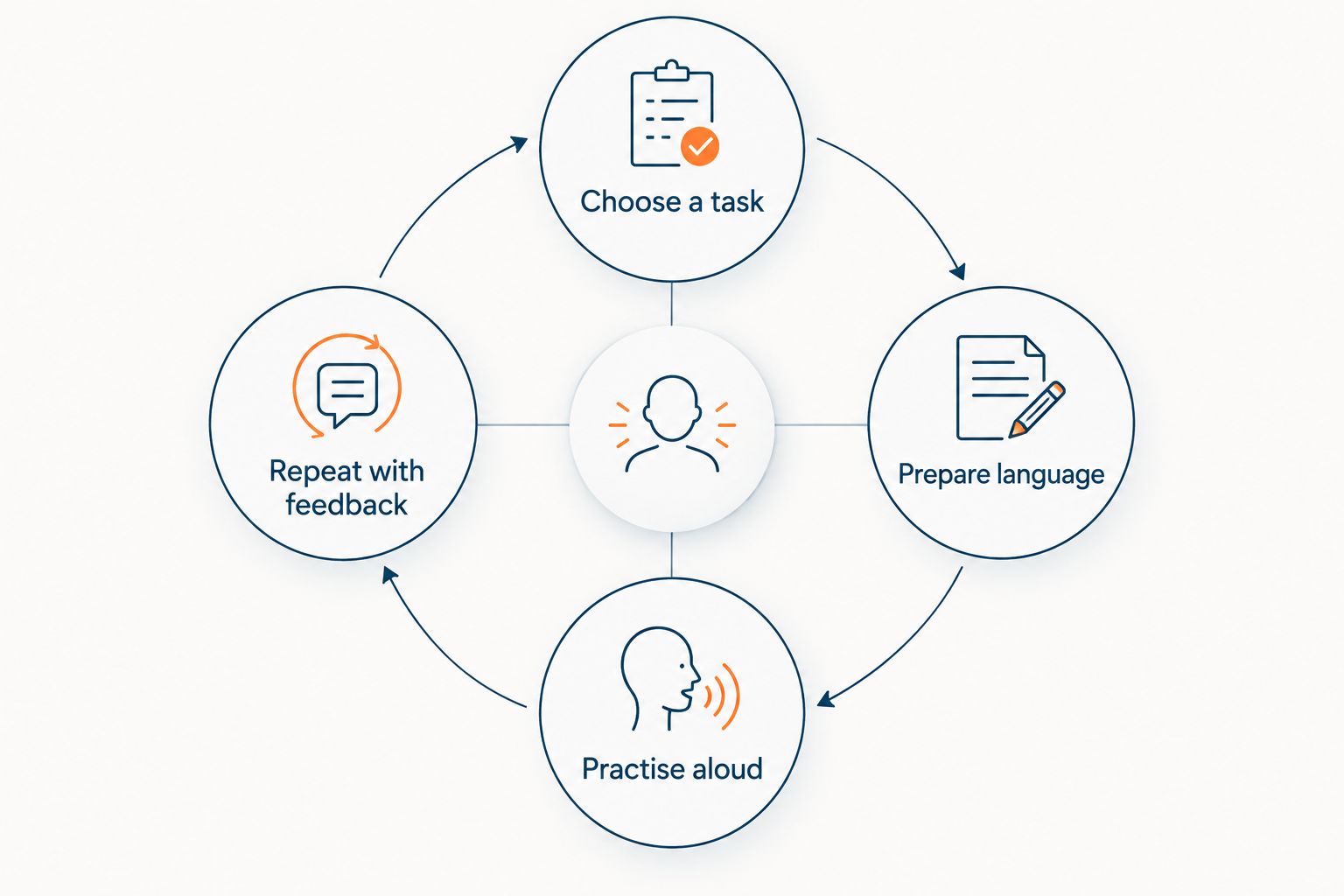
The course supplies material and instruction. Your practice cycle connects them to the work you need to do. Keep confidential names, figures, and documents out of exercises unless your employer explicitly permits their use.
How we ranked these options
This 2026 ranking prioritizes format fit, workplace relevance, feedback opportunities, and the connection between study and practice. It is a use-case comparison, not a claim that every provider was tested under identical conditions.
Individual tutoring takes the default position because it gives a professional direct tutor interaction. Group learning, structured workplace coursework, and entrepreneurship-focused study each win a separate slot because they address different needs.
Which business English course should you choose?
Flalingo is the best business English option here for professionals who want individual lessons with certified native tutors. Choose British Council English Online when group interaction is the priority, the University of Washington specialization for a structured workplace curriculum, or the University of Pennsylvania course for entrepreneurial English.
For your 2026 decision, name the task first and select the format second. If you cannot explain what you want to do better at work, refine the goal before committing to a course.
FAQ
What's the best online English course for business professionals?
The best choice depends on the task and learning format you need. Choose individual tutoring for focused speaking practice, live groups for interaction, or structured coursework for an organized workplace curriculum.
Is business English different from general English?
Business English focuses on communication tasks used at work, including meetings, presentations, negotiation, and professional writing. You still need general grammar, vocabulary, and listening skills to perform those tasks.
Should I choose private lessons or group classes?
Choose private lessons when individual attention is the priority, and group classes when you need interaction with different speakers. Group classes require you to share speaking time; private lessons do not reproduce a multi-person discussion.
Can an online course help me speak better in meetings?
An online course supports meeting preparation when it includes relevant language and speaking practice. Rehearse interruptions, clarification questions, and decision summaries rather than studying meeting vocabulary alone.
Is a university business English course enough for speaking practice?
A university course is not a substitute for live conversation when spontaneous speaking is your main goal. Use its topics and assignments to prepare, then practise responding to another person's questions.
How do I choose a business English course as a beginner?
Check the course's stated language requirements and sample material before enrolling. If you cannot follow the instructions, prioritize foundational English while practising simple workplace tasks.
How can I practise business English without sharing confidential information?
Replace real names, figures, and documents with fictional details while keeping the communication task the same. Follow your employer's rules before using workplace material in any lesson or assignment.
One last thing
Your clearest progress check is a repeated task, not a growing list of completed lessons. Save an early attempt at explaining a project, then revisit the same explanation after applying feedback.
Listen for a clearer point, a more direct request, and a better response to questions. Choose the course that helps you perform the task—not merely recognize the vocabulary.